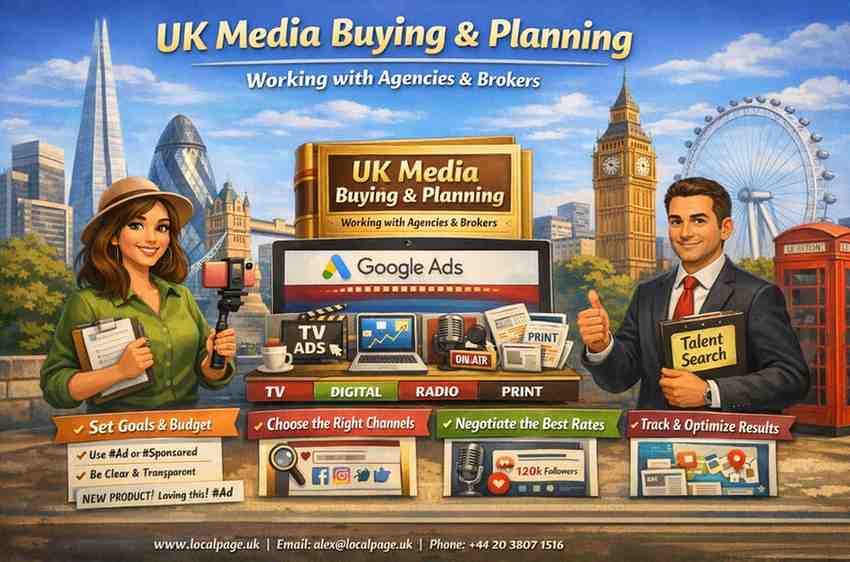
UK Media Buying & Planning: How to work with UK-based agencies and brokers
Navigating the complex landscape of business advertising UK requires expertise, strategic planning, and industry connections that many businesses simply don’t have in-house. This is where UK-based media buying agencies and brokers become invaluable partners, helping businesses maximize their advertising impact while optimizing budget allocation. As we progress through 2026, the media buying landscape continues to evolve rapidly, with new technologies, platforms, and consumer behaviors reshaping how businesses connect with their target audiences across the United Kingdom.
Effective media buying and planning is no longer just about securing ad space at the best possible rates. Today’s successful campaigns require a sophisticated understanding of audience targeting, cross-channel integration, performance measurement, and regulatory compliance. Whether you’re a small business looking to establish a local presence or a national brand seeking to optimize your advertising spend, working with the right media buying partner can transform your business advertising UK strategy from good to exceptional.
Understanding the UK Media Buying Landscape in 2026
The UK media buying landscape has undergone significant transformation in recent years, driven by digital disruption, changing consumer behaviors, and evolving regulatory frameworks. Traditional media buying—focused primarily on securing television, radio, and print advertising space—has given way to a more complex ecosystem that encompasses digital platforms, programmatic advertising, and data-driven targeting approaches.
Today’s UK media buying agencies operate at the intersection of technology, creativity, and data analytics. They leverage sophisticated tools and platforms to identify optimal advertising opportunities across an increasingly fragmented media landscape. A London-based media buying agency, for instance, recently helped a retail client achieve a 40% increase in return on ad spend by implementing a cross-channel strategy that combined traditional television advertising with targeted digital retargeting campaigns.
The consolidation of media ownership has also impacted the UK media buying landscape. A handful of major players now control significant portions of the UK media market, creating both challenges and opportunities for advertisers. Media buying agencies with established relationships across these media owners can often secure preferential rates and placement opportunities that would be inaccessible to individual businesses.
The Role of Media Agencies in Business Advertising UK
Media agencies play a multifaceted role in contemporary business advertising UK strategies, serving as strategic advisors, negotiators, and implementation partners. Their value extends far beyond simply securing ad space at competitive rates—they bring market intelligence, audience insights, and performance optimization capabilities that can significantly enhance advertising effectiveness.
At the strategic level, media agencies help businesses develop comprehensive media plans that align with their overall marketing objectives and target audience. This includes analyzing market trends, identifying optimal media channels, and determining the most effective allocation of advertising budget across different platforms. A Manchester-based media agency recently helped a B2B software company restructure their media plan, shifting budget from underperforming trade publications to targeted LinkedIn advertising, resulting in a 65% increase in qualified leads.
Beyond strategic planning, media agencies provide critical implementation services, including campaign management, performance tracking, and optimization. They handle the complex technical aspects of digital advertising, from ad trafficking to pixel implementation, allowing businesses to focus on their core operations. This expertise is particularly valuable in the rapidly evolving digital advertising landscape, where new platforms and technologies emerge regularly.
Choosing the Right Media Agency: A Strategic Approach
Selecting the right media agency partner is one of the most critical decisions a business can make regarding their business advertising UK strategy. The ideal agency should not only have the technical capabilities and industry connections but also a deep understanding of your specific market, audience, and business objectives.
Begin by evaluating agencies based on their experience in your specific industry or with similar businesses. An agency that understands the unique challenges and opportunities of your sector will be better positioned to develop effective media strategies. A Birmingham-based healthcare company, for instance, achieved significantly better results after switching to an agency with specialized expertise in healthcare advertising, who understood the regulatory constraints and audience nuances of their market.
For businesses seeking comprehensive media buying support, business advertising platform UK solutions offer an alternative to traditional agency relationships. These platforms combine technology and expertise to deliver targeted advertising solutions with transparent pricing and performance measurement.
Consider the agency’s approach to data and analytics. In today’s media landscape, data-driven decision making is essential for optimizing advertising performance. The best agencies combine sophisticated analytics capabilities with human insight to develop strategies that are both quantitatively sound and creatively effective. Ask potential agencies about their measurement frameworks, reporting practices, and how they use data to optimize campaigns in real-time.
Finally, assess the cultural fit and communication style of potential agency partners. The most successful agency relationships are built on trust, transparency, and collaborative problem-solving. Look for agencies that view themselves as strategic partners rather than simply service providers, and who demonstrate a genuine interest in understanding your business and objectives.
Traditional vs Modern Media Planning: Finding the Right Balance
The evolution from traditional to modern media planning represents one of the most significant shifts in business advertising UK over the past decade. While traditional media planning focused primarily on reach and frequency across established channels like television, radio, and print, modern approaches incorporate digital channels, data-driven targeting, and performance optimization into a more integrated framework.
Traditional media channels still maintain relevance in certain contexts and for specific audience segments. Television, for instance, remains powerful for building broad brand awareness, particularly among older demographics. A Glasgow-based home improvement company recently achieved a 25% increase in brand recognition through a strategic television advertising campaign that complemented their digital efforts.
Modern media planning, however, offers unprecedented targeting capabilities and measurement precision. Digital channels allow businesses to reach specific audiences based on demographics, interests, behaviors, and even real-time intent. A Leeds-based e-commerce retailer, for example, increased their conversion rate by 45% by implementing a programmatic advertising strategy that targeted users who had previously visited their website but hadn’t made a purchase.
The key to successful media planning in 2026 is finding the right balance between traditional and digital approaches based on your specific objectives, audience, and budget. This requires a deep understanding of how different channels work together to guide customers through their decision journey. A Bristol-based financial services company achieved optimal results by using television advertising to build awareness and digital channels to capture and convert interested prospects.
Cost Breakdown: Understanding Media Buying Fees and Structures
Understanding the cost structures associated with media buying is essential for budgeting effectively and evaluating the value provided by agencies. The UK media buying industry has evolved from traditional commission-based models to more transparent fee structures that align agency compensation with client success.
Traditionally, media agencies earned revenue through commissions paid by media owners, typically 15% of the media spend. This model created potential conflicts of interest, as agencies had incentives to recommend higher-spending campaigns regardless of effectiveness. While this model still exists in some contexts, it has largely been replaced by more transparent approaches.
Today, most UK media agencies operate on fee-based models, which may include retainers, project fees, or performance-based compensation. Retainer models provide predictable costs for both agencies and clients, with agencies charging a fixed monthly fee for ongoing services. A Manchester-based technology company, for instance, pays a monthly retainer to their media agency for strategic planning, campaign management, and optimization services.
Performance-based models tie agency compensation directly to campaign results, such as leads generated, sales achieved, or return on ad spend. These models can be highly effective but require clear measurement frameworks and agreed-upon attribution models. A Liverpool-based e-commerce brand implemented a hybrid model that combined a base retainer with performance bonuses for achieving specific conversion targets, resulting in better alignment between the company and their agency.
When evaluating agency costs, consider the total value delivered rather than just the fee percentage. A lower-cost agency that delivers poor results may ultimately be more expensive than a higher-priced agency that achieves superior performance. Similarly, agencies that provide additional value through strategic insights, creative input, or proprietary technology may justify higher fees through enhanced campaign performance.
Step-by-Step Guide to Working with UK Media Agencies
Establishing a productive relationship with a media agency requires a structured approach that ensures alignment, clarity, and mutual understanding. By following a systematic process, businesses can maximize the value of their agency partnerships and achieve better results from their business advertising UK investments.
Step 1: Define Your Objectives and Expectations
Before approaching agencies, clearly define what you want to achieve through your advertising efforts. Whether your goal is to increase brand awareness, generate leads, drive sales, or enter new markets, having specific, measurable objectives will guide the agency relationship and provide a basis for evaluating success. A Cardiff-based professional services firm developed a detailed brief outlining their target audience, key messages, and performance expectations, which helped them identify agencies with relevant expertise.
Step 2: Research and Shortlist Potential Agencies
Identify agencies with experience in your industry or with similar business models. Look for case studies, client testimonials, and industry recognition that demonstrate their capabilities. Consider both large, full-service agencies and specialized boutique firms, as each offers distinct advantages. A Birmingham-based consumer goods company created a shortlist of five agencies, including both large multinational firms and local specialists, to ensure a comprehensive comparison.
Step 3: Issue a Request for Proposal (RFP)
Develop a comprehensive RFP that outlines your business, objectives, target audience, budget range, and evaluation criteria. Request information about the agency’s approach, team structure, relevant experience, and proposed fee structure. A Glasgow-based technology company included a mock challenge in their RFP, asking agencies to outline how they would approach a specific campaign scenario, which provided valuable insight into their strategic thinking.
Step 4: Evaluate Proposals and Conduct Interviews
Assess proposals based on how well they address your specific needs and objectives, rather than just comparing costs. Conduct interviews with the teams who would be working on your account to assess cultural fit and communication style. A London-based retail brand invited their top three agency candidates to present their approaches, allowing them to evaluate both the strategic recommendations and the team dynamics.
Step 5: Negotiate Terms and Formalize the Agreement
Once you’ve selected an agency, negotiate the terms of your agreement, including scope of work, fees, performance metrics, and termination clauses. Ensure all expectations are clearly documented in a formal contract. A Leeds-based manufacturing company worked with legal counsel to develop a comprehensive agreement that included specific performance benchmarks and recourse if targets weren’t met.
Step 6: Establish Communication and Reporting Protocols
Set clear expectations for communication frequency, reporting formats, and decision-making processes. Regular performance reviews should be built into your relationship to ensure continuous alignment and optimization. A Bristol-based e-commerce brand established weekly performance calls and monthly strategic reviews with their agency, creating a framework for ongoing optimization and accountability.
Geotargeting Strategies for UK Media Campaigns
The United Kingdom’s diverse regional markets present both challenges and opportunities for advertisers seeking to connect with specific geographic audiences. Effective geotargeting strategies allow businesses to tailor their business advertising UK efforts to the unique characteristics of different cities, regions, and communities, significantly improving campaign relevance and performance.
Digital advertising platforms offer sophisticated geotargeting capabilities that allow businesses to reach audiences with remarkable precision. Google Ads, for instance, enables targeting by postcode, radius around a specific location, or even based on user location history. A Manchester-based restaurant chain increased foot traffic by 30% by implementing geotargeted search ads that appeared to users within a 5-mile radius of their locations during peak dining hours.
Social media platforms provide equally powerful geotargeting options, allowing businesses to reach users based on their current location, home location, or recent travel to specific areas. A Birmingham-based event organizer successfully promoted a local music festival by targeting Facebook users aged 18-35 within a 50-mile radius who had shown interest in similar artists or events.
For traditional media channels, geotargeting is less precise but still valuable. Regional television and radio stations, local newspapers, and out-of-home advertising in specific locations all allow businesses to focus their messaging on particular geographic areas. A Glasgow-based home services company achieved excellent results by combining radio advertising on local stations with digital geotargeting, creating a comprehensive local presence that drove significant inquiry volume.
When implementing geotargeted campaigns, it’s important to consider regional differences in culture, language, and consumer behavior. Messaging that resonates in London might not have the same impact in Manchester or Edinburgh. A Liverpool-based retailer discovered that adapting their creative to include local references and dialect significantly improved campaign performance in different regions.
Measuring ROI in Media Buying: Analytics and Performance Metrics
Effective measurement is essential for optimizing media buying strategies and demonstrating the value of advertising investments. In today’s data-driven landscape, businesses and their agency partners must implement comprehensive measurement frameworks that connect media activities to business outcomes, enabling continuous optimization and informed decision-making.
The foundation of effective media measurement is proper tracking infrastructure. Implementing conversion tracking across all digital channels allows businesses to connect specific media placements to valuable outcomes like leads, sales, or other conversions. A Leeds-based e-commerce retailer implemented enhanced e-commerce tracking in Google Analytics, allowing them to attribute sales directly to specific campaigns and optimize their media allocation accordingly.
Beyond direct response metrics, businesses should measure the impact of media activities on brand awareness and perception. Surveys, brand lift studies, and social listening tools can provide valuable insight into how advertising is affecting brand metrics. A London-based financial services company conducted pre- and post-campaign surveys to measure the impact of their television advertising on brand awareness and consideration, providing a more complete picture of campaign performance.
Attribution modeling represents one of the most significant challenges in media measurement. With customers typically encountering multiple touchpoints before converting, understanding the relative contribution of each channel is essential for optimal budget allocation. A Birmingham-based retailer moved from last-click attribution to a data-driven attribution model, which revealed that their display advertising was more influential than previously believed, leading to a reallocation of budget and a 20% increase in overall return on ad spend.
For businesses working with media agencies, regular performance reporting and review meetings are essential for maintaining alignment and optimizing strategy. These reviews should focus not just on what happened, but why it happened and what can be learned for future campaigns. A Manchester-based technology company implemented a bi-weekly performance review process with their agency, resulting in continuous optimization and a 35% improvement in cost per acquisition over six months.
Voice Search Optimisation in Media Planning
As voice search continues to grow in popularity across the UK, optimizing media strategies for voice queries has become an important consideration for forward-thinking advertisers. With an estimated 50% of UK households expected to own smart speakers by 2026, voice search represents both a challenge and opportunity for business advertising UK strategies.
Voice search queries differ from traditional text searches in several important ways. They tend to be longer, more conversational, and often take the form of complete questions. To optimize for voice search, media strategies must account for these differences, focusing on natural language and question-based content. A Glasgow-based home services company adjusted their search advertising strategy to target longer, conversational queries like “What’s the best emergency plumber near me?” rather than just “plumber Glasgow,” resulting in a 25% increase in qualified leads.
Featured snippets, also known as “position zero” in search results, are particularly important for voice search optimization, as voice assistants often read these snippets aloud in response to queries. Media strategies should include efforts to secure featured snippet placements for relevant queries. A Bristol-based financial advisor increased their voice search visibility by creating content that directly answered common financial planning questions, resulting in featured snippet placements for several high-value queries.
Audio advertising opportunities are also emerging as voice search grows. Smart speaker advertising, podcast sponsorships, and streaming audio ads all provide ways to reach audiences in voice-first environments. A London-based beauty brand achieved significant brand lift by sponsoring a popular beauty podcast, reaching engaged listeners in an audio-first context.
For businesses with physical locations, local voice search optimization is particularly critical. Ensuring your business information is accurate and consistent across all online platforms is essential, as voice assistants often pull this information when responding to location-based queries. A Cardiff-based restaurant saw a 30% increase in voice search-driven inquiries after optimizing their online listings with detailed information about their location, hours, and menu.
AI and Semantic SEO in Modern Media Planning
Artificial intelligence and semantic search technologies are transforming the media planning landscape, offering new capabilities for targeting, optimization, and performance measurement. These technologies enable more sophisticated approaches to business advertising UK that can significantly improve campaign effectiveness and efficiency.
AI-powered programmatic advertising platforms now handle the majority of digital media buying in the UK, using machine learning algorithms to optimize bids, targeting, and placement in real-time. These systems can analyze vast amounts of data to identify patterns and opportunities that human buyers might miss. A Manchester-based e-commerce retailer implemented an AI-powered bidding strategy that automatically adjusted bids based on likelihood of conversion, increasing their return on ad spend by 35% while reducing manual campaign management time.
Semantic search technologies are changing how businesses approach content and SEO as part of their media strategies. Rather than focusing solely on keywords, semantic search seeks to understand the intent and contextual meaning behind queries. This requires creating comprehensive, topic-focused content that addresses the full range of questions and concerns related to a product or service. A Leeds-based legal firm increased their organic search visibility by 70% by developing comprehensive content hubs that addressed all aspects of specific legal topics, rather than focusing on individual keywords.
AI is also transforming audience targeting and segmentation. Rather than relying on predefined demographic segments, AI systems can identify micro-audiences based on behavior, interests, and propensities to convert. A Birmingham-based fashion retailer used AI-powered audience segmentation to identify previously unknown customer segments, resulting in a 25% increase in conversion rates among these newly identified groups.
For businesses looking to leverage AI and semantic technologies in their media planning, affordable business advertising UK solutions can provide access to advanced capabilities without requiring extensive in-house technical expertise. These platforms use AI and machine learning to optimize targeting, bidding, and placement based on performance data, delivering better results with less manual effort.
Conversion Strategy: Turning Media Exposure into Business Results
Effective media buying is only valuable if it drives meaningful business results. A strong conversion strategy ensures that the reach and awareness generated by media campaigns translate into leads, sales, and other valuable outcomes. By optimizing every stage of the customer journey, from initial exposure to final conversion, businesses can maximize the return on their media investments.
Landing page optimization is critical for converting media traffic into leads or customers. Your landing pages should align closely with your ad messaging, providing a seamless experience that reinforces the value proposition presented in your ads. A Liverpool-based digital marketing agency increased their conversion rate by 50% by creating dedicated landing pages for each media campaign, with messaging and design that directly reflected the corresponding ads.
Call-to-action (CTA) optimization can significantly impact conversion rates. Your CTAs should be clear, compelling, and prominently displayed, using action-oriented language that encourages users to take the desired next step. A Glasgow-based e-commerce retailer tested multiple CTA variations and discovered that “Add to Basket for Free Delivery” performed 30% better than their original “Add to Basket” button, highlighting the importance of communicating value in your CTAs.
Trust signals are particularly important for converting media traffic, as users may be visiting your website for the first time after seeing an advertisement. Customer reviews, testimonials, security badges, and professional design all help build credibility and reduce purchase anxiety. A Cardiff-based financial services company increased their lead conversion rate by 40% by prominently displaying customer testimonials and industry accreditations on their landing pages.
Finally, consider the entire conversion funnel, not just the final conversion point. Many customers require multiple touchpoints before converting, so implement strategies to capture leads at earlier stages of the decision process. Email newsletters, downloadable guides, and webinars can all capture leads who aren’t ready to make an immediate purchase but represent future conversion opportunities. A Manchester-based B2B software company increased their overall conversion rate by 60% by implementing a comprehensive lead nurturing system that guided prospects through a multi-week educational journey before presenting a sales offer.
Case Study: Successful Media Buying for a UK Retail Brand
To illustrate the power of effective media buying and planning, let’s examine the case of HomeStyle Living, a Birmingham-based furniture retailer that successfully transformed their business advertising UK strategy through a partnership with a specialized media agency. In early 2025, the company was struggling with declining foot traffic and online sales despite offering quality products at competitive prices.
Their transformation began with a comprehensive audit of their existing media efforts, which revealed several issues: inconsistent messaging across channels, poor integration between online and offline activities, and inadequate measurement of campaign performance. The company partnered with a media agency that specialized in retail marketing, who developed a new strategy that addressed these issues while expanding their reach across multiple channels.
The new strategy began with a clear segmentation of their target audience, with specific messaging and channel approaches for each segment. For younger, design-conscious customers, the agency focused on social media advertising and influencer partnerships. For more established homeowners, they emphasized traditional media channels like television and magazine advertising, complemented by targeted digital campaigns.
Perhaps most importantly, the company implemented a comprehensive measurement framework that connected media activities to sales both online and in-store. By using unique discount codes for different campaigns and conducting customer surveys to understand how customers discovered the brand, they were able to accurately attribute sales to specific media activities and optimize their strategy accordingly.
This case study demonstrates how a strategic, data-driven approach to media buying can transform business results. By focusing on understanding their customers, delivering consistent messaging across channels, and measuring performance rigorously, HomeStyle Building created a media engine that drives sustainable growth and provides a clear competitive advantage.
Common Mistakes to Avoid in UK Media Buying
Even with the best intentions, businesses often make common mistakes that undermine their media buying effectiveness. By being aware of these pitfalls, you can avoid wasted investment and maximize the impact of your business advertising UK initiatives.
One of the most common mistakes is failing to define clear objectives and KPIs before launching campaigns. Without specific goals and measurement systems in place, it’s impossible to evaluate success or optimize performance. A London-based consumer goods brand spent significant budget on a national advertising campaign without establishing clear conversion tracking, making it impossible to determine which elements of the campaign were driving results.
Another frequent mistake is inconsistent messaging across media channels. When customers encounter different brand messages, value propositions, or visual identities across different platforms, it creates confusion and undermines brand recognition. A Manchester-based service company discovered that their inconsistent messaging across television, digital, and print advertising was confusing potential customers and reducing campaign effectiveness.
Neglecting mobile optimization is another critical mistake in today’s mobile-first world. With over 70% of UK internet traffic coming from mobile devices, media campaigns that don’t provide a seamless mobile experience miss significant opportunities. A Birmingham-based retailer discovered that over 60% of their ad traffic came from mobile devices, yet their website wasn’t fully optimized for mobile users, resulting in poor conversion rates and wasted ad spend.
Finally, many businesses fail to test and optimize their media approaches, instead running the same campaigns indefinitely regardless of performance. The most effective advertisers continuously test different messages, creative approaches, targeting parameters, and channels, using performance data to refine and improve their approach over time. A Liverpool-based professional services firm increased their conversion rate by 45% through systematic A/B testing of their ad creative and landing pages.
2026 Trends: The Future of Media Buying in the UK
As we look toward the future of business advertising UK, several emerging trends are poised to reshape the media buying landscape. Staying ahead of these developments will help businesses maintain their competitive edge and connect with audiences in new and meaningful ways.
Privacy-first advertising is becoming increasingly important as consumers demand greater control over their personal data and regulations like GDPR and the ePrivacy Directive continue to evolve. Forward-thinking businesses are shifting from third-party data reliance to first-party data strategies, building direct relationships with customers and seeking explicit consent for data collection and use. A Glasgow-based software company increased their email conversion rates by 50% by implementing transparent data practices and giving customers clear control over their privacy settings.
Contextual advertising is experiencing a resurgence as privacy concerns and the phasing out of third-party cookies reshape the digital advertising landscape. Rather than targeting based on individual user behavior, contextual advertising places ads in relevant content environments. A Manchester-based travel company increased their click-through rates by 35% by implementing a contextual advertising strategy that placed their ads in travel-related content rather than relying solely on behavioral targeting.
Artificial intelligence is transforming every aspect of media buying, from planning and targeting to optimization and measurement. AI-powered tools can analyze vast amounts of data to identify patterns and opportunities that human buyers might miss. A London-based e-commerce retailer implemented AI-powered budget allocation that automatically shifted spend to the best-performing channels in real-time, increasing their overall return on ad spend by 40%.
Finally, the integration of online and offline media experiences is creating new opportunities for seamless customer journeys. Technologies like QR codes, augmented reality, and interactive out-of-home advertising are bridging the gap between physical and digital media. A Birmingham-based retailer used interactive billboards that allowed passersby to browse products and make purchases using their smartphones, creating a novel shopping experience that drove significant sales.
Building a Sustainable Media Buying Strategy for UK Success
Developing a sustainable media buying strategy requires a systematic approach that balances short-term results with long-term brand building. By implementing a structured process, businesses can create effective business advertising UK campaigns that deliver consistent value over time.
Step 1: Conduct a Comprehensive Audit
Begin by evaluating your current media activities, including channels, messaging, performance, and costs. Identify what’s working well and what isn’t, and look for opportunities to improve integration and measurement. A Leeds-based manufacturing company discovered through an audit that they were overspending on underperforming trade publications while neglecting digital opportunities, leading to a strategic reallocation of budget.
Step 2: Define Clear Objectives and KPIs
Establish specific, measurable objectives for your media efforts, whether focused on awareness, engagement, leads, or sales. Develop key performance indicators that align with these objectives and will allow you to measure success accurately. A Bristol-based professional services firm defined clear KPIs for each media channel, allowing them to optimize their mix based on each channel’s strengths.
Step 3: Develop an Integrated Media Plan
Create a comprehensive media plan that outlines how different channels will work together to guide customers through their decision journey. Consider how awareness, consideration, and conversion activities will be integrated across channels. A Glasgow-based retailer developed a media plan that used television for awareness, search and social for consideration, and email marketing for conversion, creating a seamless customer journey.
Step 4: Implement Robust Measurement Systems
Establish tracking and measurement systems before launching campaigns to ensure you can accurately assess performance. Implement conversion tracking, attribution modeling, and regular reporting processes. A Manchester-based e-commerce brand implemented enhanced analytics and attribution modeling, which revealed previously hidden connections between channels and informed their optimization strategy.
Step 5: Optimize Continuously Based on Performance Data
Regularly review performance data and optimize your media approach based on results. Shift budget to high-performing channels and tactics, and refine or eliminate underperforming elements. A Liverpool-based services company implemented bi-weekly optimization reviews, resulting in continuous improvement and a 30% increase in overall campaign efficiency over six months.
Step 6: Foster Strong Agency Partnerships
If working with media agencies, cultivate relationships based on transparency, collaboration, and shared objectives. Regular communication and performance reviews ensure alignment and continuous improvement. A Cardiff-based brand held quarterly strategic planning sessions with their agency, resulting in more proactive and strategic media planning.
Frequently Asked Questions About UK Media Buying & Planning
Media buying costs vary significantly based on scope, channels, and agency model. Most businesses allocate 10-15% of their total advertising budget to agency fees, though this can range from 5% for large accounts to 25% for smaller, more hands-on relationships. Consider the total value delivered rather than just the fee percentage.
Media buying agencies specialize specifically in media planning, negotiation, and placement, while full-service agencies offer broader capabilities including creative development, strategic planning, and sometimes PR. Media buying specialists often have deeper expertise in media optimization and stronger media owner relationships.
Timeline varies by channel and objectives. Direct response campaigns can generate results within days, while brand awareness campaigns may take weeks or months to show measurable impact. Most UK businesses begin seeing initial results within 2-4 weeks, with optimal performance typically achieved after 2-3 months of optimization.
Both have advantages. Local agencies often have deeper understanding of regional markets and may offer more personalized service. National agencies typically have broader resources and specialized expertise. Consider your specific needs—local focus might favor local agencies, while national campaigns might benefit from national agency resources.
Small businesses can compete by focusing on niche targeting, leveraging hyper-local opportunities, and emphasizing agility and creativity. Micro-targeting and local media often provide better ROI than broad national campaigns. Many agencies offer specialized services for small businesses with scalable pricing models.
Programmatic advertising now accounts for over 80% of digital display advertising in the UK. It uses automated technology and data to buy and optimize digital ads in real-time. Programmatic offers precise targeting, efficiency, and measurement capabilities that traditional media buying cannot match.
While digital dominates in terms of spend, traditional media still plays an important role, particularly for building broad awareness and reaching certain demographics. The most effective strategies integrate both traditional and digital media based on specific audience and campaign objectives.
Key elements include scope of work, deliverables, fee structure, performance metrics, reporting requirements, term length, and termination clauses. Contracts should also specify ownership of assets, confidentiality provisions, and clear expectations for communication and decision-making processes.
GDPR and the e-Privacy Directive have significantly impacted media buying by restricting data collection and use. This has led to a shift toward first-party data strategies, contextual advertising, and greater transparency. Businesses must ensure their media buying practices comply with these regulations or face significant penalties.
Key trends include privacy-first advertising, the resurgence of contextual targeting, growth in connected TV advertising, AI-powered optimization, and the integration of online and offline experiences. Sustainability messaging and authentic brand purpose are also becoming increasingly important to UK consumers.
Ready to transform your media buying strategy and drive measurable results? Contact Local Page UK today for expert guidance on effective media planning and buying solutions tailored to your business needs.
Email: alex@localpage.uk | Phone: +44 20 3807 1516 | Website: www.localpage.uk
Wrapping Up: Building Strategic Partnerships for Media Success
Effective media buying and planning is more critical than ever in today’s complex business advertising UK landscape. As we’ve explored throughout this guide, the most successful media strategies combine strategic planning, data-driven optimization, creative execution, and strong measurement frameworks to deliver measurable business results.
The right media agency partner can transform your advertising effectiveness, bringing specialized expertise, industry connections, and advanced capabilities that would be difficult to develop in-house. By selecting an agency that understands your business, market, and objectives, you create a partnership that drives continuous improvement and sustainable growth.
Looking ahead, the media buying landscape will continue to evolve rapidly, shaped by technological advancements, regulatory changes, and shifting consumer behaviors. Businesses that remain agile, embrace data-driven decision making, and prioritize customer experience will be best positioned to succeed in this dynamic environment.
Whether you’re a small business looking to establish a local presence or a national brand seeking to optimize your advertising spend, the principles outlined in this guide can help you develop and refine a media buying strategy that delivers measurable results. By focusing on clear objectives, comprehensive measurement, and continuous optimization, you can build a media engine that drives sustainable growth and competitive advantage.
For personalized guidance on implementing these strategies for your specific business, reach out to the team at Local Page UK. Our experts specialize in helping UK businesses navigate the complex media landscape and develop strategies that drive real business results. Contact us today to schedule a consultation and take your media buying to the next level.
 LocalPage UK Food Directory & Dining Guide
Leave a comment